
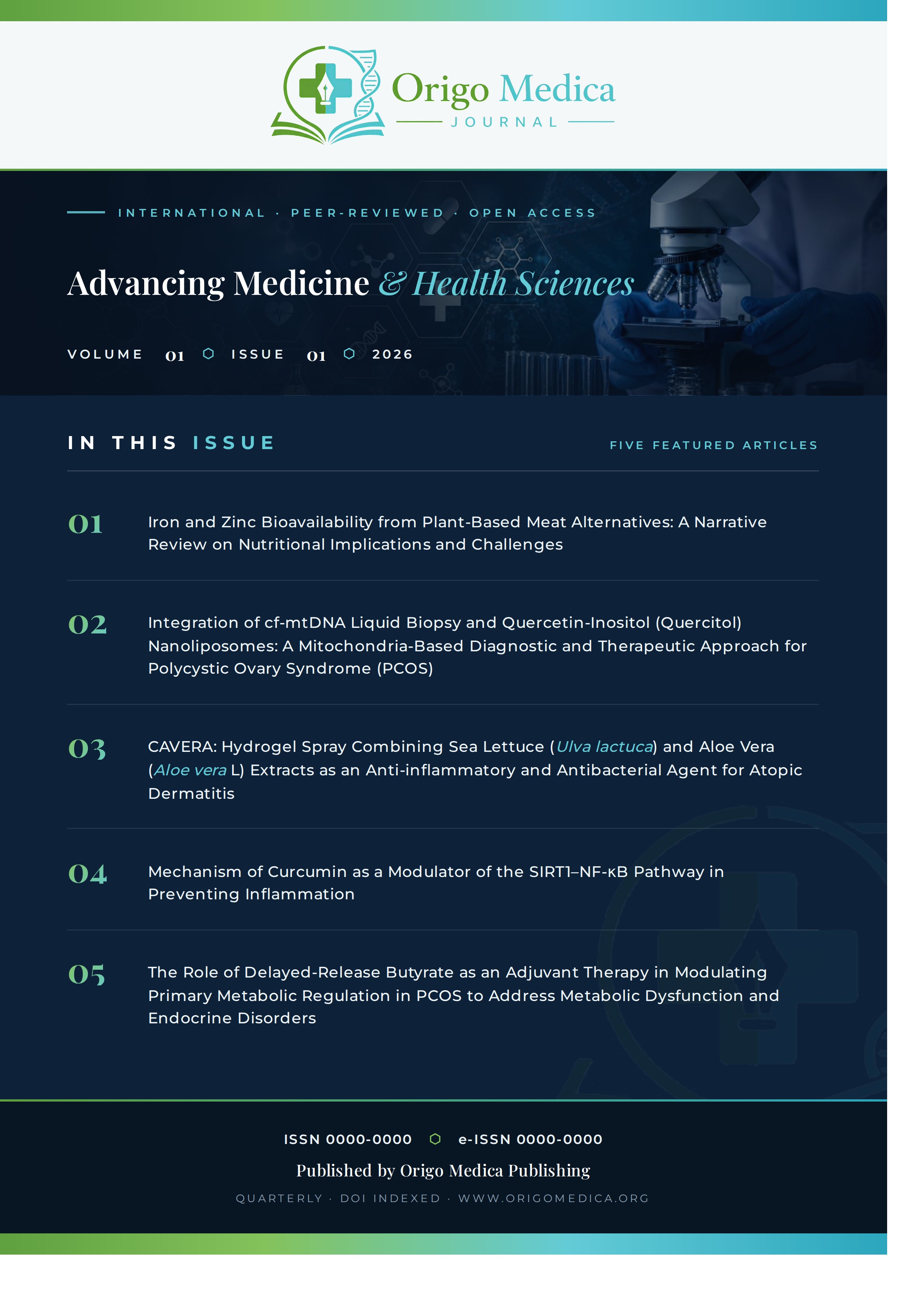
The Role of Delayed-Release Butyrate as an Adjuvant Therapy in Modulating Primary Metabolic Regulation in PCOS to Address Metabolic Dysfunction and Endocrine Disorders
Kata Kunci:
Butyrate, Delayed-Release, Dysbiosis, Gut Microbiota, PCOCAbstrak
PCOS is a complex endocrine–metabolic disorder characterized by hyperandrogenism, ovulatory dysfunction, insulin resistance, and low-grade chronic inflammation, significantly impacting reproductive, metabolic, and cardiometabolic health in women of reproductive age. Gut dysbiosis, particularly reduced populations of SCFA producing bacteria, including butyrate, contributes to increased intestinal permeability, LPS translocation, activation of TLR4-NFκB inflammatory pathways, and impaired insulin signaling, exacerbating insulin resistance, hyperandrogenism, and ovarian phenotype. This review aimed to evaluate delayed-release butyrate as an adjuvant therapy in PCOS through modulation of primary metabolic pathways via the gut‑brain‑ovary axis, intestinal barrier enhancement, and local ovarian immunomodulation. Literature search was performed in PubMed, Web of Science, Science Direct, Elsevier, and Google Scholar using keywords combining PCOS, butyrate, delayed-release, gut microbiota, insulin resistance, metabolic dysregulation, with inclusion of articles from the past 10 years assessing SCFA or butyrate on metabolism, inflammation, and ovarian function. Results indicate that butyrate supplementation, particularly delayed-release formulations, increases local SCFA concentrations in the colon, strengthens tight junctions, suppresses proinflammatory cytokines, reduces endotoxemia, and modulates the gut‑brain‑ovary axis, improving insulin resistance, reproductive hormone profile, and estrous cyclicity in preclinical models, with support from preliminary clinical data. Compared to standard therapies such as metformin or inositol, butyrate provides a unique mechanism complementing systemic metabolic effects through microbiota modulation, SCFA restoration, and ovarian inflammation regulation. In conclusion, delayed-release butyrate has potential as an adjuvant therapy in PCOS by targeting gut dysbiosis, primary metabolic dysregulation, and local ovarian inflammation, supporting future controlled clinical trials and personalized microbiota-based therapeutic strategies.
Referensi
Salari N, Nankali A, Ghanbari A, Jafarpour S, Ghasemi H, Dokaneheifard S, et al. Global prevalence of polycystic ovary syndrome in women worldwide: a comprehensive systematic review and meta-analysis. Archives of Gynecology and Obstetrics [Internet]. 2024 Jun 26;310(3):1303–14. Available from: https://pubmed.ncbi.nlm.nih.gov/38922413/
Qotrunnada Salsabila W 1, Adyani K 2, Realita F, Universitas Islam Sultan Agung, Semarang, Indonesia. Perbandingan Pengetahuan dan Sikap tentang PCOS pada Mahasiswi Kesehatan dan Non Kesehatan [Internet]. Vol. 4, Griya Widya: Journal of Sexual and Reproductive Health. 2024 Dec p. 25–38. Available from: https://journal.nurscienceinstitute.id/index.php/griyawidya
BPS-Statistics Indonesia. (May 9, 2025). Jumlah Penduduk Menurut Kelompok Umur dan Jenis Kelamin, 2025. Retrieved on January 21, 2026, from https://www.bps.go.id/en/statistics-table/3/WVc0MGEyMXBkVFUxY25KeE9HdDZkbTQzWkVkb1p6MDkjMw==/jumlah-penduduk-menurut-kelompok-umur-dan-jenis-kelamin.html?year=2025
Prosperi S, Chiarelli F. Insulin resistance, metabolic syndrome and polycystic ovaries: an intriguing conundrum. Frontiers in Endocrinology [Internet]. 2025 Oct 1;16:1669716. Available from: https://doi.org/10.3389/fendo.2025.1669716
Fitz V, Graca S, Mahalingaiah S, Liu J, Lai L, Butt A, et al. Inositol for Polycystic Ovary Syndrome: A systematic review and meta-analysis to inform the 2023 update of the International Evidence-based PCOS Guidelines. The Journal of Clinical Endocrinology & Metabolism [Internet]. 2024 Jan 2;109(6):1630–55. Available from: https://pubmed.ncbi.nlm.nih.gov/38163998/
He, Ff., Li, Ym. Role of gut microbiota in the development of insulin resistance and the mechanism underlying polycystic ovary syndrome: a review. J Ovarian Res 13, 73 (2020). https://doi.org/10.1186/s13048-020-00670-3
Zhao M, Chen D, Hu X, Xie C, Xu L and Zhou F (2025) Gut-Ovary Axis in Polycystic Ovary Syndrome: Mechanistic Insights and Gut Microbiota-Targeted Therapeutic Strategies. Front. Endocrinol. 16:1684492. doi: 10.3389/fendo.2025.1684492
Mei Y, Li W, Wang B, Chen Z, Wu X, Lin Y, Wang M. Gut microbiota: an emerging target connecting polycystic ovarian syndrome and insulin resistance. Front Cell Infect Microbiol. 2025 Mar 11;15:1508893. doi: 10.3389/fcimb.2025.1508893. PMID: 40134784; PMCID: PMC11933006.
Liu, K., He, X., Huang, J. et al. Short-chain fatty acid-butyric acid ameliorates granulosa cells inflammation through regulating METTL3-mediated N6-methyladenosine modification of FOSL2 in polycystic ovarian syndrome. Clin Epigenet 15, 86 (2023).https://doi.org/10.1186/s13148-023-01487-9
Su P, Chen C, Sun Y. Physiopathology of polycystic ovary syndrome in endocrinology, metabolism and inflammation. Journal of Ovarian Research [Internet]. 2025 Feb 20;18(1):34. Available from: https://doi.org/10.1186/s13048-025-01621-6
Hajam YA a, Rather HA b, Neelam, Kumar R c, Basheer M d, Reshi MS e. A review on critical appraisal and pathogenesis of polycystic ovarian syndrome [Internet]. Vol. 14, Endocrine and Metabolic Science. 2024 Jan p. 100162. Available from: https://doi.org/10.1016/j.endmts.2024.100162
Szkodziak P, Szkodziak F, Trzeciak K, Woźniak S, Mlynarczyk M, Paszkowski T. Insulin resistance in polycystic ovary syndrome phenotypes and the vicious cycle model in its etiology. Scientific Reports [Internet]. 2025 Nov 28;15(1):42649. Available from: https://pubmed.ncbi.nlm.nih.gov/41315368/
Dutta S, Sengupta P, Rao S, Elgarawany GE, Samrot AV, Rosas IM, et al. Targeting Polycystic Ovary Syndrome (PCOS) Pathophysiology with Flavonoids: From Adipokine–Cytokine Crosstalk to Insulin Resistance and Reproductive Dysfunctions. Pharmaceuticals [Internet]. 2025 Oct 18;18(10):1575. Available from: https://doi.org/10.3390/ph18101575
Senthilkumar, H., Arumugam, M. Gut microbiota: a hidden player in polycystic ovary syndrome. J Transl Med 23, 443 (2025). https://doi.org/10.1186/s12967-025-06315-7
Maddirevula MK, Nelson VK, Soliman M, Alanazi BK, Hegazy AMS, Baig HA, Soliman AM, Alanazi M. Effect of probiotic-derived metabolites on hormonal and metabolic profiles in women with polycystic ovary syndrome: a systematic review and meta-analysis. Front Cell Infect Microbiol. 2025 Nov 19;15:1680840. doi: 10.3389/fcimb.2025.1680840. PMID: 41346361; PMCID: PMC12672546.
Xia XY, Chen Y, Zhang XJ, Wang J, Xu HY, Zhao R. Gut microbiota dysbiosis and short-chain fatty acid depletion in phlegm-dampness polycystic ovary syndrome: a cross-sectional 16S rRNA sequencing analysis. BMC Endocrine Disorders [Internet]. 2025 Nov 10;25(1):255. Available from: https://doi.org/10.1186/s12902-025-02076-y
Ouyang X, Zhou Q, Tang H, Li L. Pathogenesis and treatment of obesity-related polycystic ovary syndrome. Journal of Ovarian Research [Internet]. 2025 Nov 14;18(1):258. Available from: https://doi.org/10.1186/s13048-025-01817-w
Li P, Shuai P, Shen S, Zheng H, Sun P, Zhang R, et al. Perturbations in gut microbiota composition in patients with polycystic ovary syndrome: a systematic review and meta-analysis. BMC Medicine [Internet]. 2023 Aug 9;21(1):302. Available from: https://doi.org/10.1186/s12916-023-02975-8
Li Q, Chen L, Wang R. Exercise reshapes gut microbiota to ameliorate core symptoms in PCOS: molecular mechanisms and therapeutic implications. Frontiers in Endocrinology [Internet]. 2025 Oct 29;16:1652731. Available from: https://doi.org/10.3389/fendo.2025.1652731
Recharla N, Geesala R, Shi XZ. Gut microbial metabolite butyrate and its therapeutic role in inflammatory bowel disease: a literature review. Nutrients [Internet]. 2023 May 11;15(10):2275. Available from: https://doi.org/10.3390/nu15102275
Caban M, Pikus E, Czarnecka-Chrebelska K, Oszajca K, Witusik-Perkowska M, Dudek J, et al. Use of Sodium Butyrate and its Microencapsulated Forms in Intestinal Diseases—Current Clinical Approach. Digestive Diseases and Sciences [Internet]. 2025 Nov 14; Available from: https://doi.org/10.1007/s10620-025-09536-4
Tursi A, Procaccianti G, De Bastiani R, Turroni S, D’Amico F, Allegretta L, et al. Micro-encapsulated and colonic-release sodium butyrate modulates gut microbiota and improves abdominal pain in patients with symptomatic uncomplicated diverticular disease. Frontiers in Medicine [Internet]. 2025 Feb 26;12:1487892. Available from: https://pmc.ncbi.nlm.nih.gov/articles/PMC11897004/
Patra S, Chelikani PK. Microencapsulated propionate and butyrate improved energy balance and gut microbiota composition in Diet-Induced obese rats. Nutrients [Internet]. 2025 Jun 30;17(13):2180. Available from: https://doi.org/10.3390/nu17132180
Olaniyi KS, Areloegbe SE, Badejogbin OC, Ajadi IO, Ajadi MB. Butyrate-Mediated modulation of paraoxonase-1 alleviates cardiorenometabolic abnormalities in a rat model of polycystic ovarian syndrome. Cardiovascular Drugs and Therapy [Internet]. 2024 Nov 16;39(6):1275–87. Available from: https://pubmed.ncbi.nlm.nih.gov/39549177/
Feng X, Xiao J, Wang D, Fu X, Gao J, Jiang M, et al. Butyric acid ameliorates PCOS-related reproductive dysfunction through gut-brain-ovary axis signaling and ovarian steroidogenic factor activation. Frontiers in Endocrinology [Internet]. 2025 Jul 9;16:1604302. Available from: https://pubmed.ncbi.nlm.nih.gov/40704148/
Greff D, Juhász AE, Váncsa S, Váradi A, Sipos Z, Szinte J, et al. Inositol is an effective and safe treatment in polycystic ovary syndrome: a systematic review and meta-analysis of randomized controlled trials. Reproductive Biology and Endocrinology [Internet]. 2023 Jan 26;21(1):10. Available from: https://pubmed.ncbi.nlm.nih.gov/36703143/
Homburg R, et al; International Evidence‑Based Guideline for the Assessment and Management of Polycystic Ovary Syndrome 2023. Fertil Steril. 2023;120(4):767–793. Available from: https://www.asrm.org/practice-guidance/practice-committee-documents/recommendations-from-the-2023-international-evidence-based-guideline-for-the-assessment-and-management-of-polycystic-ovary-syndrome/
Mukherjee, A. G., Wanjari, U. R., Kannampuzha, S., Murali, R., Namachivayam, A., Ganesan, R., Dey, A., Babu, A., Renu, K., Vellingiri, B., Ramanathan, G., Priya Doss C., G., Elsherbiny, N., Elsherbini, A. M., Alsamman, A. M., Zayed, H., & Gopalakrishnan, A. V. (2023). The Implication of Mechanistic Approaches and the Role of the Microbiome in Polycystic Ovary Syndrome (PCOS): A Review. Metabolites, 13(1), 129. https://doi.org/10.3390/metabo13010129
Unduhan
Diterbitkan
Terbitan
Bagian
Lisensi
Hak Cipta (c) 2026 Origo Medica Journal

Artikel ini berlisensi Creative Commons Attribution 4.0 International License.
The copyright of the received article shall be assigned to the journal as the publisher of the journal. The intended copyright includes the right to publish the article in various forms (including reprints). The journal maintains the publishing rights to the published articles.
This work is licensed under a Creative Commons Attribution 4.0 International License.