Peer Review Process
Peer Review Process
Origo Medica Journal implements a rigorous double-blind peer review system to ensure the quality, integrity, and scientific validity of all published articles. In this process, both author and reviewer identities are concealed throughout the review procedure to maintain impartiality and objectivity.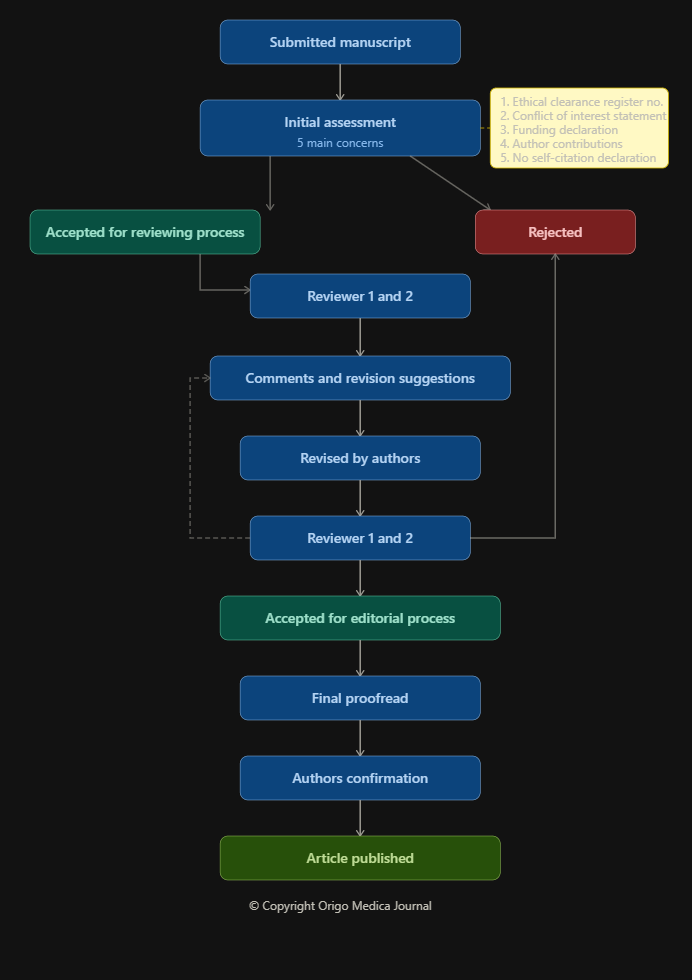
1. Manuscript Submission
Authors are required to prepare manuscripts in accordance with the journal submission guidelines and double-blind review standards.
To facilitate anonymous peer review, authors must submit:
-
A Title Page containing:
-
Full manuscript title
-
Author names
-
Institutional affiliations
-
Corresponding author details (email address and contact information)
-
-
A Blinded Manuscript containing:
-
No author names or affiliations
-
No acknowledgments
-
No funding identifiers
-
No institutional identifiers within the text, figures, or file properties
-
Authors should also:
-
Use third-person narration when referring to previous work by the authors;
-
Remove metadata and author-identifying information from document properties;
-
Ensure figures and supplementary files do not contain institutional or author identifiers;
-
Limit self-citations only to relevant references necessary for scientific context.
2. Initial Editorial Assessment
After submission, the manuscript undergoes an initial editorial screening conducted by the editorial office.
This assessment includes evaluation of:
-
Suitability with the journal’s aims and scope;
-
Manuscript structure and formatting compliance;
-
English language quality and readability;
-
Ethical compliance and plagiarism screening;
-
Completeness of submission requirements.
Manuscripts that do not meet the journal’s minimum requirements may be returned to the authors for correction or rejected prior to peer review.
3. Double-Blind Peer Review
Manuscripts that pass the initial assessment are assigned to at least two independent reviewers with expertise relevant to the submitted topic.
Reviewers evaluate manuscripts based on:
-
Scientific originality;
-
Methodological quality;
-
Clinical or academic relevance;
-
Ethical standards;
-
Clarity of presentation;
-
Validity of conclusions.
Reviewers may recommend one of the following decisions:
-
Accept;
-
Minor Revision;
-
Major Revision;
-
Reject.
Reviewer comments and recommendations are communicated anonymously to the authors through the journal system.
4. Revision Process
Authors receiving revision requests are expected to:
-
Respond carefully to all reviewer comments;
-
Submit a revised manuscript;
-
Provide a detailed response letter explaining all revisions made.
The revised manuscript may be returned to the original reviewers for re-evaluation when necessary.
Failure to submit revisions within the specified timeline may result in withdrawal of the manuscript from the review process.
5. Final Editorial Decision
After peer review and revision are completed, the Editor-in-Chief or assigned editor makes the final publication decision based on:
-
Reviewer recommendations;
-
Scientific quality;
-
Ethical compliance;
-
Editorial standards of the journal.
The final decision may include:
-
Acceptance for publication;
-
Additional revision requests;
-
Rejection.
6. Copyediting and Proofreading
Accepted manuscripts proceed to the editorial production stage, including:
-
Copyediting;
-
Grammar and language correction;
-
Layout formatting;
-
Reference checking;
-
Proof preparation.
Authors will receive page proofs for final review and approval prior to publication.
7. Online Publication
Following final author approval, the article will be published online and assigned to an issue of Origo Medica Journal.
All published articles become openly accessible through the journal website in accordance with the journal’s open access policy.
8. Publication Ethics
All manuscripts submitted to Origo Medica Journal are evaluated according to international publication ethics standards, including guidelines from:
-
COPE (Committee on Publication Ethics)
-
ICMJE Recommendations
-
International standards for scholarly publishing integrity
Any suspected ethical misconduct, plagiarism, duplicate publication, or data manipulation will be handled according to established ethical procedures.